
Exstrom Laboratories
Copyright 2021
Exstrom Laboratories LLC
A CO2 (carbon dioxide) meter with temperature pressure humidity
Have you ever been stuck in a meeting listening to Mr. I. M. Boring droning on and on while you get sleepier and sleepier? Well it may not just be Mr. Boring that's making you fall asleep. Some of your stupor may be due to the amount of CO2 (carbon dioxide) in the air. Everyone sitting at the table and all the dogs and cats underneath the table are producing CO2 with every breath. So how do you tell if the CO2 is too high? Well luckily there are sensors that can measure it. The two most common low cost and semi-accurate sensors are called non-dispersive infrared (NDIR) and photoacoustic (PA) sensors.
The following is a photoacoustic CO2 sensor project that we use to monitor the CO2 levels in our home and work environment. The project is completely open source. You can download all the software for the project below.
The following figure shows all the basic components of the project as well as how they are connected together.
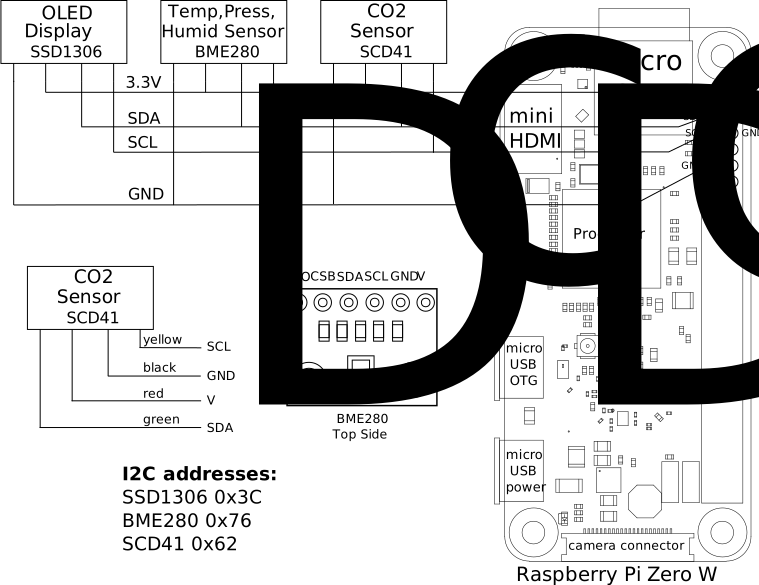
As you can see from the figure we are using a Sensirion SCD41 CO2 PA sensor connected to a Raspberry Pi Zero W. Also connected to the Raspberry are a BME280 for pressure-temperature-humidity, as well as an SSD1306 OLED display for showing real-time data.
Importance of CO2 in the indoor environment
Outdoor CO2 levels are usually around 400 ppm. At the time of this writing, on Sept 3, 2021 at 14:47, our City of Longmont air quality station is giving us a CO2 reading of 412 ppm, while at the Mauna Loa Observatory the present reading is 411.66 ppm. Due largely to vehicles, fertilizer production, and electricity generation using fossil fuels, the average CO2 level has been increasing by about 2.5 ppm per year. IPCC 2013 projects that outdoor CO2 levels will be well over 1000 ppm by the end of this century, at which point we're probably all going to die, but that's another story.
Another source of CO2 is human beings along with dogs,
cats, hamsters and all other animals. So when you put a bunch of them
together in a building, things can get a bit stuffy. This
CO2 is a basic byproduct of human metabolism. The
CO2 is produced inside human and animal cells by these
little energy factories called mitochondria. The main energy molecule in the human cell is called
adenosine triphosphate (ATP).
The mitochondria manufacture ATP, using glucose as an energy source,
in a complex process that can be
summarized by the following chemical reaction:
C6H12O6 + 6O2 →
6CO2 + 6H2O
The inputs to this reaction are
one glucose molecule and 6 oxygen molecules. The products are 6
CO2 and 6 water molecules. Which eventually end up in the
bloodstream. So your blood is essentially like carbonated water. The
more CO2 dissolved in carbonated water, the more acidic it
becomes. The lungs remove the CO2 from the blood in an
attempt to keep the acidity from getting too high.
This is why, indoors - without houseplants - the
CO2 level will never get lower than the outdoor level.
With no open windows or other ventilation, the more people and/or
animals in a room or building, the higher the CO2 level
will be. The
Active House Specifications, 3rd ed, 2020 defines excellent
indoor air quality as being less than 400 ppm above the outdoor reading.
The CO2 level in buildings and homes is often used as a
proxy for air quality. See this article from the Washington Post for example:
The coronavirus is airborne. Here’s how to know if you’re breathing other people’s breath
Many countries (Canada, Germany, Norway, Japan, South Korea, Taiwan, China) have set an upper limit guideline of 1000 ppm for CO2 inside non-industrial buildings. Even at moderately elevated indoor CO2 levels, noticeable physiological effects are possible. At above 500 ppm, there can be increased heart rate and changes in heart rate variability. At above 1000 ppm, cognitive performance begins to suffer.
Copyright 2021 by Exstrom Laboratories LLC