
Exstrom Laboratories
Copyright 2005-2020
Exstrom Laboratories LLC
Photodiodes
The term photodiode usually refers to a solid state device that is used to detect and measure light. Vacuum tube photodiodes do exist and are sometimes used in speciallized applications such as x-ray and gamma-ray detection but they will not be covered here.
A photodiode is very similar to a standard pn junction diode. Any diode can be a photodiode to the extent to which photons can reach its pn junction. For example an LED can be used as a photodiode. It will be most sensitive to light near the wavelength it emits when forward biased. The solar cells used to generate electrical power are also essentially photodiodes.
Photodiodes are usually operated in reverse or zero bias. When photons strike the junction they create electron-hole pairs which form the photo or light current. The exact mechanism by which the creation of electron-hole pairs turns into a current is not exactly clear, see for example [1]. In any case the photon generated current flows out of the diode opposite to the normal flow of current when it is forward biased. We will call this photon generated current the photocurrent. It may also be called the reverse light current.
Figure 1 shows a circuit model for a photodiode. The photocurrent is represented by the \(I_p\) current source. The diode is an ideal diode that is modeled by the Shockley diode equation. It represents the behavior of the photodiode in the absence of light.
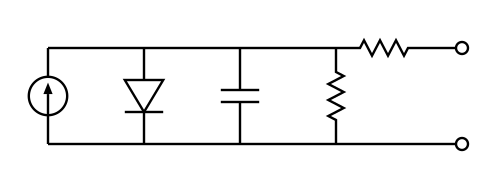
The capacitor \(C_p\) is the junction capacitance that is present in any pn junction diode. It is important in applications where response time is critical such as in high speed optical data communication. In applications that require the precision measurement of a more or less static light intensity, or an average light intensity, \(C_p\) is not that important. It can however affect the stability of a transimpedance amplifier used to convert the photocurrent to a voltage.
The resistance \(R_p\) is the bulk resistance of the material and is often in the 10 to 100 gigaohm range. In many cases it can be ignored. The exception may be germanium diodes where the resistance is much lower. The resistance \(R_s\) is a contact resistance that is usually low enough to be ignored.
The current source \(I_p\) is powered by light hitting the photodiode. There is an approximate linear relationship between \(I_p\) and the power of the incident light \(P\).
\begin{equation*} I_p=rP \end{equation*}The proportionality constant \(r\) is called the responsivity of the photodiode.
Copyright 2007-2021 by Exstrom Laboratories LLC